Turkeys
Gero
I think of him every few months, and as we close 2025 I find I am missing my former colleague, and friend, Ludgero “Gero” Leonardo — 2025 is 10 years since he passed.
I took this photo on one our first trips together to Dell’s TX campus in March 2003 — we had decided to spend the weekend visiting the Alamo, the San Antonio Riverwalk, and the Tower of the Americas.
Gone, but never forgotten.

Yaesu FTM-500DR

The Yaesu FTM-500DR is their flagship product, it’s about $500, but it’s got so many small gripes it’s almost as if no one on their team has actually used a radio in a vehicle…
- Powering It Off — Why do I need to hold the power button to shut it down? A single press or a double press should shut it off… instead they’ve decided the single press of the power button will lock it…
- Locking Out a Memory Channel During Scanning — Each memory channel has a SCAN attribute of YES/NO… setting this takes about 10 steps… ten steps! So if you’re scanning around and hit on something you want to skip, you essentially can’t…
- Memory Scanning, All or Nothing — There’s no apparent way to break up what memory channels you do scan — it’s all the channels or none.
- SD Card is Half Baked — Using an SD Card to be able to program the radio seems like a great idea, but in practice both the RT Systems and Yaesu software don’t seem to work well with it… Neither of the software packages recognize that the Yaesu radio itself will save multiple copies of the data by incrementing a number on the file… so you have to go manually rename files… and while opening saved files in the software seems to work fine, the other direction hasn’t worked at all for me… it either fails or corrupts the radio and requires reprogramming by cable, this is true even if I format the card in the radio to have just a single saved version…
- USB – Serial Cable — Why are still transferring data to these radios from a PC using serial? It takes ages to move data at 9600bps which seems unnecessary…
- No Ignition Sense — I know this isn’t common on mobile radios, but I really don’t understand why not… the radio is connected to the battery, why not provide an input to let the radio be powered on/off along w/ the ignition w/o requiring relays and hard power cuts?
- Audio Recording — I love the audio recording feature, but it’s recording in uncompressed audio with support for only a 32GB card… recording to a compressed format would let you store much more audio on the card
- Audio Recording Part II — Quite a bit of the functions are persistent through power cycling, like memory scan, but unfortunately recording is not, so you need to start it each time (fortunately you can set one of the P-keys on the mic for that)
Maybe these are issues w/ all radios, maybe I’m not using it like most others would, but these are fairly annoying quirks. It’s only been a few weeks, so maybe it’ll grow on me…
TNC-Pi on 64-bit Linux
I decided that I wanted to run an APRS iGate at my house because I found that low power transmissions in my neighborhood simply aren’t making it to the nearest Digipeater.
My current setup is a Mobilinkd 4 + iPhone SE 2020 + aprs.fi — but it’s not working very reliably — What I’m finding that is that every 2-3 days it stops beaconing and stops receiving packets… if I unlock the iPhone and fiddle it starts working, I’ll get a day or two, and then it will stop. My assumption is that iOS is simply not geared to run background applications like this and so it doesn’t work as a “set it and forget it” type of system.
That lead me to a purchase I made a long time ago… When I was first getting into APRS I bought a Coastal Chipworks TNC-Pi — it’s a TNC in the form of a Raspberry Pi “hat”, and I recall that it worked fairly well at the time using a Raspberry Pi 3B. I don’t fully recall what my goal at the time was, but it was using in a vehicle and ultimately when I found the Mobilinkd that worked out better. I parked the hardware, but pulled the Micro-SD.
Fast-forward a decade or so and I’ve decided to resurrect the TNC-Pi in the hopes that I can use it as an iGate and doing RF beaconing.
I’m grateful that despite having not sold this product for quite a while (I think over 5 years at this point?) the website linked above is still operational with instructions and files… but what I found was that time marched on in the world of Raspberry Pi development and left these little setup/helper apps behind.
If you try to run pitnc_getparams and see this message:
-bash: ./pitnc_getparams: cannot execute: required file not foundThat means you’re likely running a 64-bit version of Raspbian / Raspberry Pi OS, but these applications are built for 32-bit.
You have two options:
- Install a 32-bit version of Raspbian / Raspberry Pi OS
- Install the required 32-bit libraries
If you decide to take the option 2 route — installing 32-bit libraries — these are the two fairly straight-forward commands I had to run to get going:
sudo dpkg --add-architecture armhf
sudo apt install libc6:armhf
After that, you’ll find that both 32-bit helper applications are able to run on your 64-bit OS.
It’s 2013 again… at least when it comes to my amateur radio rig
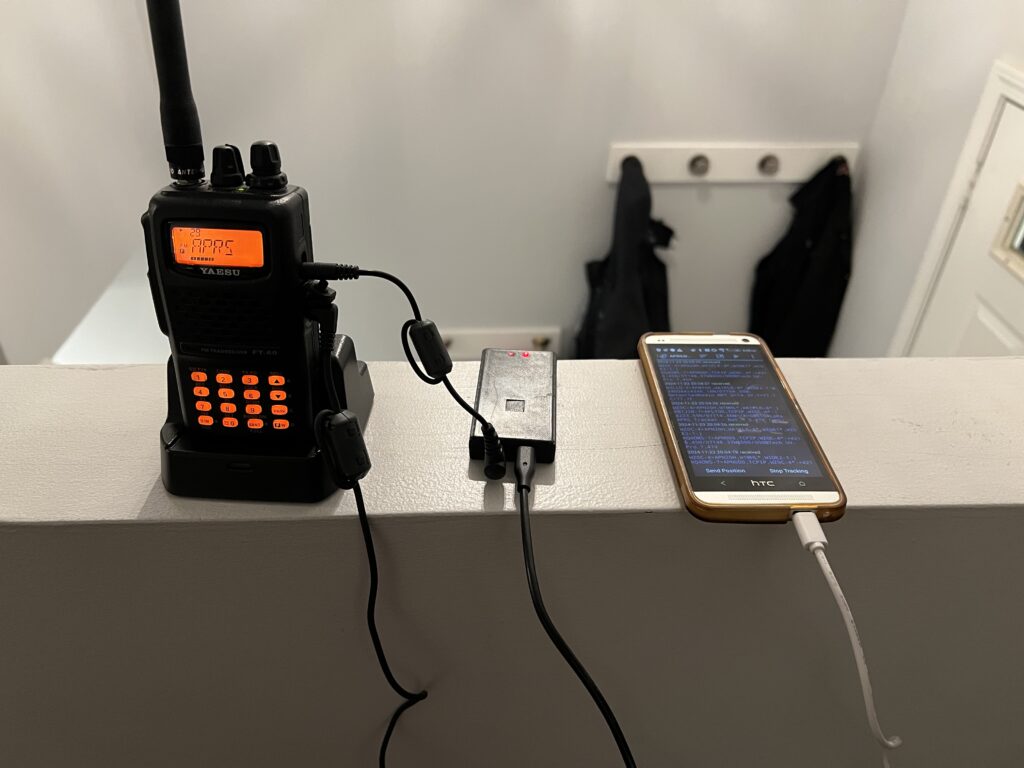
They don’t make em like they used to, but I’d have probably said that in 2013 when I bought that HTC One phone and the Yaesu radio… yet they’re both still kicking over 11 years later running APRSdroid. The TNC is a Mobilinkd TNC 2.1 bought in 2016.
I’m not much for talking on the radio, but I do love telemetry and packet radio.
If you subscribe to only one youtube channel…
Consider this one: https://www.youtube.com/@SimonFordman
Simon creates very compelling videos about working on older vehicles — in each one he tells a story while sharing his love of the hobby, and the trials of working on these relics, all without saying a word — he uses interesting angles, relaxed but captivating pacing, and carefully chosen visuals and sounds, as well a few (optional) captions.
I look forward to every video he makes, and if this post helps even 1 person find his channel then I’ll be very happy.
1977 Cadillac Sedan deVille
In late October 2022 I bought a 77 Cadillac from someone in CT via eBay.
It’s in surprisingly good shape, and has yet to break down — made the 100+ mile trip home and dozens of around town drives since — but I don’t have any confidence in it for situations where timing is important.
- Brakes
- Lines — I assume they’re all ready to blow
- Master Cylinder — based on speculation it’s bad
- Wheel Components — calipers/cylinders, pads/shoes, rotors/drums, all the bits and pieces, they’re not specifically bad, but have to assume they’re a liability
- Suspension
- Springs — the car sags in the rear and floats even for a Cadillac, I’m assuming the rusty 45 year old springs are done
- Shocks — replaced already, the old ones were absolute toast
- Ball Joints / Bushings — nothing feels specifically bad, but all the rubber is shot, and who knows how old the parts are
- Tie Rods / Steering — similar to above, nothing feels bad, but it’s all super old and rubber components are disintegrated
- Cooling
- Hoses — might be fine, but stamped 1992… probably gotta go
- Water Pump — I can see a mild wobble in the pulley and I thought it might be weeping some coolant
- HVAC
- Blower — initially worked on high, now not at all… not safe to drive in any situation with condensation
- HVAC Head — has a pretty obvious vacuum leak when in any position except “Off”
- Refrigerant — would be nice to be able to get cold / dry air, I remember how lousy driving in rain can be without working air conditioning
- Body
- Rust Prevention — I want to “do no harm”, so I really want to coat or other protect the underbody before I start regularly driving it
- General Mechanical
- Oil Leaks — it leaks oil, but it also seems to be leaking something else, unclear what it is, only happens while running but nothing is getting low, the fluid is viscous but has no obvious color or strong odor, it’s vaguely fuel like, but could be anything.
- Belts — not specifically bad, but good to baseline
- Vacuum leaks / Rubber — have to assume all the vacuum and fuel lines are toast at this age
I’ve got all the parts together, I believe all the tools I need, even have a garage… just need to find the time…
Backdating entries…
I don’t keep this blog up much, but occasionally it’s entertaining to me go back and look at it. With that in mind I used internet magic to retrieve entries I made in previous iterations of this blog from the past decade and add them all here w/ backdates.
I also decided to go back to the WordPress “Twenty Thirteen” theme because I sort of really like it…
CO2 is a thing…
In the recent issue of Make magazine they had a comparison of hobbyist CO2 sensors. The purpose of these meters was to help identify indoor spaces that might be more conducive to Covid spread (higher CO2 levels in a room with people means more shared air).
I decided to build one for my office because I share a small 10×12 room with a coworker. I thought seeing the CO2 might be interesting and informative… I never got that far:
What I didn’t expect was to see that my own home is quite poor when it comes to CO2 levels.
Our house is on a busy road, the traffic noise can be difficult to ignore so we often run the HVAC 24/7 even in moderate temperatures. Our house is a 1989 build, it’s all original — doors, windows, siding, etc — the HVAC is replaced but with “like kind”, meaning there’s no ERV/HRV add on, though the new heating appliances are high efficiency so they have dedicated combustion air ducts (instead of drawing air from the house).
Our house is consistently in the 800-1200ppm CO2 range when the windows have been closed for a few days. I personally haven’t felt that it was stuffy or recycled feeling, but the data doesn’t lie.
The other interesting aspect is just how much our gas range will impact CO2 levels… take a look at this annotated chart:
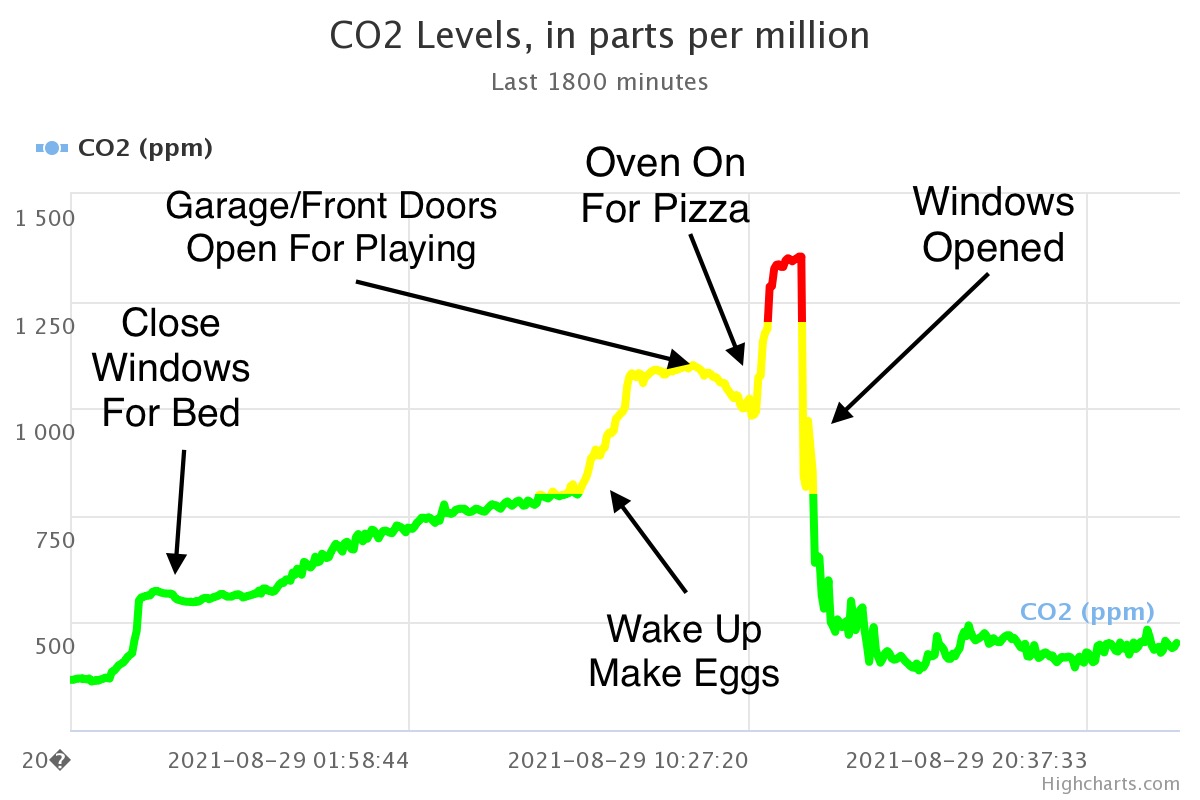
The oven running spikes the CO2 way up. I’m definitely making it a point to keep windows open as much as we can, even if the HVAC is running, to keep some fresh air in the house.
The Real Ghostbusters cartoon
The monsters, music, and situations in the show are terrifying… how was this on TV at 4PM for kids everyday in the late 80s?